 +1 (800) 844-6603
 Follow Us






The best quick service restaurant POS systems process transactions in under 10 seconds, route orders directly to a kitchen display system, and stay operational during internet outages. Toast, Square, Oracle MICROS, Lightspeed, Clover, and HungerRush lead the 2026 market — each with distinct speed, pricing, and integration trade-offs that directly affect your revenue per service hour.
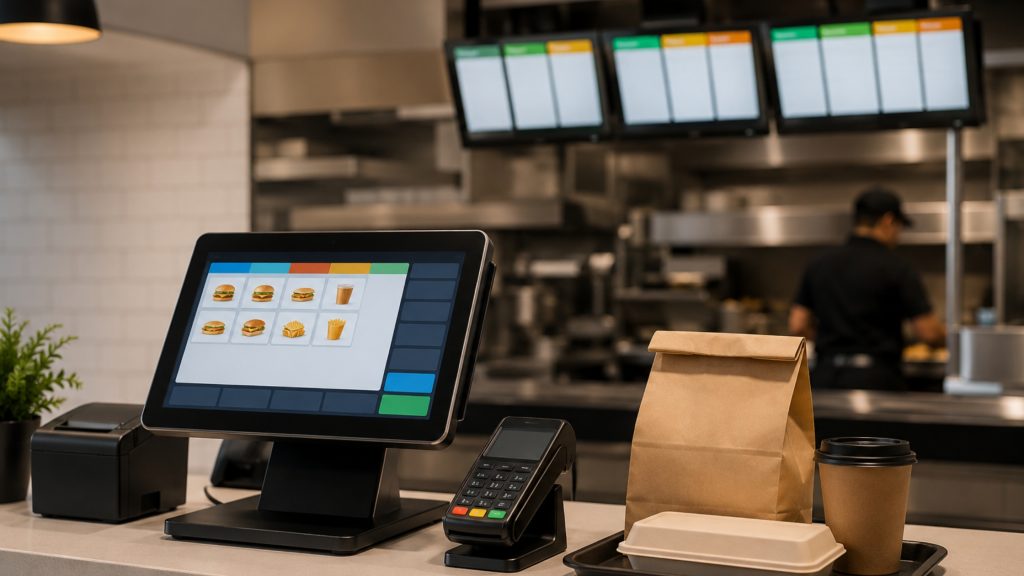
Why POS Speed Directly Affects QSR Revenue
Every second saved at the counter adds up fast. A POS that shaves 5 seconds off each transaction allows a single register to process 12 more orders per hour. At an average ticket of $10, that’s $120 in additional hourly revenue — per terminal. Across a lunch rush of 3 hours with 2 registers, slow software costs you over $700 in potential sales every single day.
Transaction throughput — measured in orders per minute — is the single most important benchmark QSR operators should demand from any vendor demo. Most vendors advertise “fast checkout” without publishing actual throughput data, so push them for numbers. A system processing 4+ transactions per minute under load is the baseline for high-volume counter service.
Checkout friction also increases error rates. When staff rush through a slow interface, wrong items get sent to the kitchen, comps go up, and ticket times stretch. A purpose-built quick service restaurant POS system eliminates that friction at the source.
The 5 Features Every QSR POS System Must Have
A quick service restaurant POS system must include fast order entry, a kitchen display system (KDS), offline payment processing, integrated online ordering, a guest-facing display, and real-time inventory management. These features reduce transaction time, minimize errors, and keep service moving during connectivity outages.
Here is the non-negotiable feature checklist for any QSR POS evaluation:
- Kitchen Display System (KDS) — Replaces paper tickets with real-time digital order routing
- Offline payment processing — Accepts cards and contactless payments without internet
- Integrated online ordering — Syncs third-party and direct orders into one queue
- Guest-facing display — Lets customers verify their order in real time, reducing disputes
- Inventory management — Tracks ingredient-level stock to prevent mid-service stockouts
Any system missing two or more of these features will create operational bottlenecks at volume. Prioritize this checklist before evaluating price.
Offline Payment Processing: Non-Negotiable for High-Volume Counters
Offline POS payment processing keeps your line moving when your ISP goes down. Square for Restaurants stores card data locally and syncs transactions once connectivity is restored, according to Square’s QSR product page. Toast’s offline mode operates similarly — it processes payments and sends orders to the KDS without an active internet connection.
What offline mode cannot do is equally important to understand. It cannot verify card authorization in real time, which means you accept a small risk of declined cards syncing after the fact. It also cannot update loyalty program balances or push orders to third-party delivery platforms until the connection returns. Know these limits before a connectivity event surprises you during a dinner rush.
Kitchen Display System (KDS) Integration and Order Latency
A kitchen display system for restaurants is only as fast as its connection to the POS. KDS latency — the delay between a cashier completing an order and that order appearing on the kitchen screen — should be under 1 second for any system you consider. Latency above 3 seconds creates a visible gap between front-of-house and kitchen, which compounds during peak volume.
Toast’s KDS integration operates on a local network, minimizing cloud-relay delays. Oracle MICROS uses dedicated hardware architecture that keeps KDS latency consistently low even across multi-station deployments. When demoing any system, time the order-to-display interval yourself using a stopwatch — vendors rarely volunteer this benchmark unprompted.
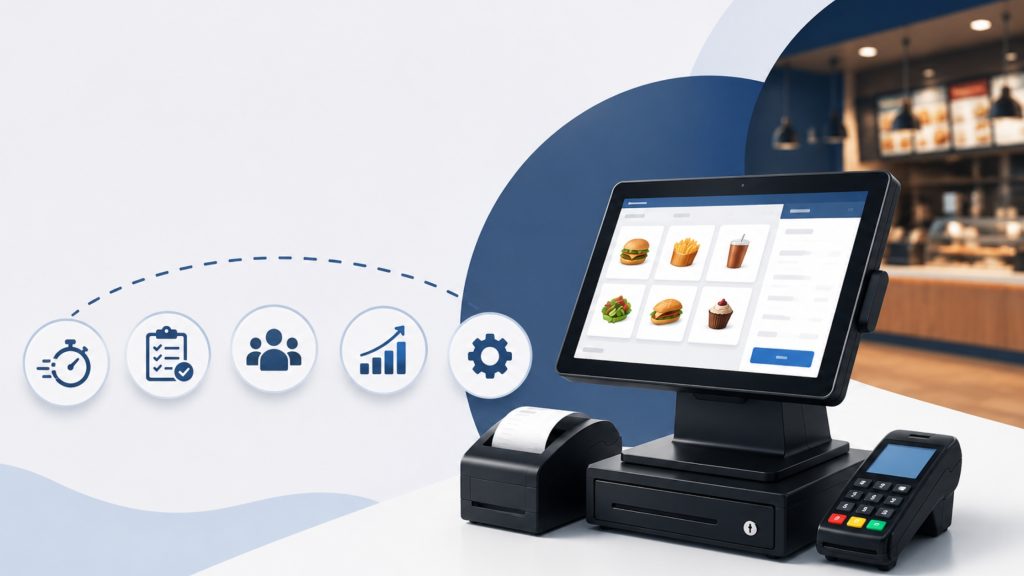
Quick Service Restaurant POS Systems Compared: 2026 Breakdown
The six dominant platforms for QSR operators in 2026 are Toast, Square for Restaurants, Oracle MICROS, Lightspeed Restaurant, Clover, and HungerRush. They differ significantly on throughput speed, pricing tiers, hardware requirements, and integration depth. Here is how they stack up across the metrics that matter most at the counter.
Toast POS: Best for High-Volume Counter Service
Toast is purpose-built for restaurants and dominates high-volume counter service for good reason. Its guest-facing display lets customers confirm orders in real time, cutting verbal correction requests by a measurable margin. Toast’s synced online ordering consolidates direct web orders, Toast TakeOut app orders, and third-party delivery tickets into a single KDS queue — eliminating the tablet sprawl that slows down most QSR kitchens.
Monthly software costs range from $0 (Starter plan, single location) to $165+ for the Point of Sale plan, with custom pricing for enterprise deployments. Hardware — including the Toast Flex terminal and KDS screen — typically runs $627–$999 upfront per station. Toast charges a processing fee of 2.49% + $0.15 per transaction on most plans.
For operators running more than 150 transactions per day, Toast’s speed and integration depth justify the cost. It is the top-ranked system for throughput in independent third-party testing.
Square for Restaurants: Best for Low-Cost Entry and Offline Reliability
Square for Restaurants offers the lowest barrier to entry of any platform on this list. The Free plan costs $0 per month and includes offline payment acceptance, a basic KDS feed, and integrated online ordering — making it genuinely competitive for new or single-location operators. Tech.co’s independent review ranks Square highest for ease of use among restaurant POS systems, citing its intuitive interface as a key factor in staff training speed.
Square’s limitations become apparent at scale. Multi-location operators cannot share inventory data across sites without third-party integrations. The reporting suite lacks the granularity that franchise operators need for labor and food cost analysis. Square also does not offer the dedicated restaurant hardware ecosystem that Toast or Oracle MICROS provide, which matters when you need a ruggedized kitchen environment.
Oracle MICROS, Lightspeed, Clover & HungerRush: At a Glance
| System | Best For | Pricing Model | Key Differentiator |
|---|---|---|---|
| Oracle MICROS | Enterprise & multi-location QSR | Custom (contact sales) | Real-time management across hundreds of locations; dedicated hardware architecture |
| Lightspeed Restaurant | Delivery-forward QSRs | From $189/month | Direct integrations with DoorDash, Uber Eats, and other delivery platforms via multi-store workflow |
| Clover POS | Compact counter setups | From $14.95/month + hardware | Flexible hardware form factors including mobile POS reader; strong business management tools |
| HungerRush | Loyalty-driven fast casual | Custom pricing | Built-in customer loyalty program and deep inventory management tied to menu engineering |
Oracle MICROS is the enterprise standard — it scales to hundreds of locations with consistent KDS performance and real-time management dashboards. Lightspeed’s delivery-platform integrations make it the strongest choice for QSRs where third-party delivery represents more than 20% of order volume. Clover’s compact hardware, including its mobile POS reader, suits operators with limited counter space. HungerRush leads on loyalty program depth and inventory management ROI for fast casual operators.
POS Pricing Models Decoded: Monthly Fees, Hardware Costs & Hidden Charges
QSR POS pricing in 2026 falls into three models: SaaS subscription, flat-rate processing, and hybrid. Understanding each prevents bill shock after you sign.
SaaS subscription (Toast, Lightspeed, Oracle MICROS) charges a fixed monthly fee for software regardless of transaction volume. Monthly fees range from $0 (Square Free) to $189+ (Lightspeed) to custom enterprise contracts exceeding $500/month for Oracle MICROS. Hardware is purchased separately and typically costs $500–$1,500 per terminal station.
Flat-rate processing (Square) bundles software and payment processing into a per-transaction fee — typically 2.6% + $0.10 for in-person payments. There is no true “no monthly fee” POS that also includes full QSR features; Square’s Free plan is the closest, but it charges processing fees on every transaction. For high-volume operators, flat-rate models become more expensive than subscription models above roughly 200 transactions per day.
Hidden charges to watch for include: offline processing fees, KDS hardware licensing, third-party delivery integration surcharges (common in Lightspeed), and per-location fees for multi-store workflow features. Always request a fully itemized quote before signing any contract.
How to Choose the Right QSR POS: A 3-Question Decision Framework
Use these three questions to narrow your shortlist before investing time in demos:
1. What is your daily transaction volume?
Under 100 transactions/day: Square Free plan handles your load without monthly fees. Over 200 transactions/day: Toast or Oracle MICROS deliver the throughput speed and reporting depth you need.
2. How many locations do you operate?
Single location: Square, Toast Starter, or Clover all work. Two or more locations: Lightspeed’s multi-store workflow or Oracle MICROS enterprise deployment are purpose-built for this complexity.
3. What integrations are non-negotiable?
Heavy delivery volume: Lightspeed’s native delivery-platform integrations reduce manual reconciliation. Loyalty program priority: HungerRush’s built-in customer loyalty program outperforms bolt-on solutions. Full restaurant ecosystem: Toast’s end-to-end suite — including payroll and scheduling — eliminates vendor fragmentation.
Operators who answer all three questions before requesting demos cut their evaluation time in half and avoid signing contracts with systems that cannot scale to their actual needs.
Bottom Line: The Fastest QSR POS Systems Ranked
Based on throughput speed, KDS integration, offline reliability, and total cost of ownership, here is the 2026 ranking for quick service restaurant POS systems:
- Toast POS — Fastest overall throughput for high-volume counter service; best KDS integration and online ordering sync. Verdict: The top choice for established QSRs doing 150+ transactions per day.
- Oracle MICROS — Best for enterprise and multi-location operators requiring consistent performance at scale. Verdict: The enterprise standard, but overkill for single-location operators.
- Square for Restaurants — Best entry-level option with genuine offline reliability and zero monthly software cost. Verdict: Ideal for new QSRs or low-volume single locations.
- Lightspeed Restaurant — Best for delivery-forward QSRs needing native third-party platform integrations. Verdict: Strong multi-store workflow, but pricing is steep for small operators.
- HungerRush — Best for loyalty-driven fast casual concepts prioritizing repeat customer revenue. Verdict: Deep loyalty program and inventory management tools justify the cost for the right operator.
- Clover POS — Best for compact counter setups with flexible hardware needs. Verdict: The mobile POS reader and modular hardware make it uniquely flexible for non-traditional QSR layouts.
No single system wins every category. Match the ranking to your transaction volume, location count, and integration requirements — and you will have a defensible, data-backed decision.
FAQs
1. Which QSR POS system processes transactions the fastest at peak service hours?
Toast POS processes transactions the fastest at peak service hours for most QSR operators. Its local-network KDS integration keeps order-to-display latency under 1 second, and its purpose-built counter service interface allows experienced staff to complete an order entry in under 8 seconds. Oracle MICROS matches Toast’s speed in enterprise deployments with dedicated hardware architecture.
2. What POS systems for quick service restaurants have no monthly fee?
Square for Restaurants is the only major QSR POS platform with a $0 monthly software fee. Its Free plan includes offline payment processing, basic KDS functionality, and integrated online ordering. However, Square charges 2.6% + $0.10 per in-person transaction, so “no monthly fee” does not mean free — it means costs scale with volume rather than being fixed.
3. What is the difference between a QSR POS and a full-service restaurant POS?
A QSR POS is optimized for speed, counter-based ordering, and high transaction volume with minimal table management. A full-service restaurant POS prioritizes table mapping, course-by-course order pacing, split checks, and server tip management. QSR systems typically have simpler interfaces designed for fast staff training and rapid order entry, while full-service systems carry more complex workflow tools that would slow down a counter environment.
4. Does a quick service restaurant POS work offline during internet outages?
Yes — the leading QSR POS systems include offline payment processing that stores card data locally and syncs once connectivity is restored. Toast, Square, and Clover all support offline mode. Offline mode cannot verify card authorization in real time or sync loyalty program data until the connection returns, so there is a small risk of declined cards discovered after the fact.
5. How much does a quick service restaurant POS system cost in 2026?
QSR POS costs in 2026 range from $0/month (Square Free plan) to $189+/month (Lightspeed) to custom enterprise pricing for Oracle MICROS. Hardware adds $500–$1,500 per terminal station. Payment processing fees typically run 2.49%–2.6% + $0.10–$0.15 per transaction. A single-location QSR operator should budget $1,000–$2,500 in upfront hardware costs plus $0–$165/month in software fees depending on the platform chosen.
6. Which POS systems integrate directly with third-party delivery platforms for QSRs?
Lightspeed Restaurant offers the deepest native integrations with third-party delivery platforms including DoorDash and Uber Eats, routing delivery orders directly into the POS and KDS queue. Toast also supports major delivery platform integrations through its Toast Online Ordering and partner integrations. HungerRush includes delivery integration as part of its QSR feature set. Square connects to delivery platforms through third-party middleware, which adds a step to reconciliation.
7. What hardware do I need to run a quick service restaurant POS system?
A baseline QSR POS hardware setup includes a touchscreen terminal or tablet (the primary order entry device), a kitchen display system (KDS) screen, a receipt printer, and a card reader or payment terminal. Higher-volume setups add a guest-facing display, a mobile POS reader for line-busting, and a cash drawer. Toast, Clover, and Oracle MICROS sell purpose-built hardware bundles; Square allows you to use compatible third-party hardware to reduce upfront costs.