 +1 (800) 844-6603
 Follow Us






Most restaurant point of sale systems handle a pizzeria badly, and they all fail in the same place: the moment a customer asks for half pepperoni, half mushroom, with extra cheese on one side.
A pizzeria POS has to model a product that is configured rather than chosen. That is a different data problem from a burger with three options, and it is the reason generic systems produce wrong tickets and wrong prices in pizza shops.
The half-and-half problem
Ask any pizza operator what breaks their POS and you will hear the same answer. A pizza divided into halves — sometimes quarters — where each section carries different toppings, and each topping has a price that depends on the size of the pizza and the fraction of it covered.
There are three common ways systems handle this, and only one is right:
| Approach | What happens | Verdict |
|---|---|---|
| Charge full price per topping per half | Customer is overcharged and argues | Wrong |
| Charge nothing for the second half | You give away toppings all day | Wrong |
| Charge a proportional price per fraction | Correct price, no argument | Right |
A system that cannot price a fraction of a topping will cost you money on every single split pizza, in one direction or the other. Test this on day one of any trial, with a real order, before anything else.
Topping logic a pizzeria POS has to get right
- Size-dependent pricing. A topping on an 18-inch pizza costs more than on a 10-inch. The system must price by size, not by a flat modifier.
- Included versus extra. A specialty pizza includes toppings. Removing one should not credit the customer; adding a sixth should charge.
- Extra and light. Double cheese charges; light cheese does not credit. Both must print clearly for the kitchen.
- Substitutions. Swapping one included topping for another of equal value should be free, and the system should know the values.
- Fractions. Halves at minimum, quarters if you sell them.
Every one of these is a pricing decision you already make verbally. The job of the software is to apply your rules consistently, on every order, including at 11pm on a Saturday when the person on the till is new.
Dough, timing and the make line
Pizza has a constraint most restaurant software ignores: the oven. Throughput is set by oven capacity, and a ticket that arrives five minutes late is a pizza that comes out after the rest of the order.
What helps in practice is ordering tickets by required oven time rather than by order time, showing the make line what to build next rather than everything outstanding, and grouping pizzas of the same size going to the same oven. A kitchen display system does this far better than a printer, because a screen can reorder itself as the queue changes.
Delivery, which is where pizzerias differ most
Pizza is the most delivery-heavy category in the industry, and a POS for pizza shops has to treat delivery as a first-class function rather than an add-on:
- Address capture and repeat customers. Regulars order the same thing to the same place. The system should recognise the phone number.
- Driver assignment and dispatch. Which driver has which orders, and when did they leave.
- Delivery zones and charges. Distance-based fees, and a hard boundary you do not cross.
- Order batching. Two deliveries on the same street should go out together, and the system should surface that.
- Driver cash reconciliation. Cash on delivery still exists, and it has to balance at the end of the night.
On commission, it is worth reading our breakdown of third-party delivery commission before you decide how much of your volume to route through marketplaces. Pizza has better direct-ordering habits than almost any other category, which makes your own ordering channel unusually effective.
Menu setup is the real project
Choosing a pizzeria POS takes a week. Configuring it properly takes considerably longer, and it is where most of the value is won or lost. A pizza menu is not a list, it is a set of rules:
- Sizes, and how each one prices toppings.
- Topping groups — meats, vegetables, cheeses — that may be priced differently from one another.
- Specialty pizzas defined as a base plus included toppings, so removals and additions behave correctly.
- Crust types, some of which carry a surcharge by size.
- Fractions, and the price rule for each fraction.
Budget real time for this, and test it with your actual best-selling orders rather than a sample menu. A configuration error in topping pricing does not announce itself; it quietly costs or overcharges on every split pizza for months.
Phone orders still matter
Pizza is one of the few categories where the telephone remains a major channel, and a good POS for pizza shops treats it properly. Caller ID that pulls up the last order, address on file, and the ability to take the order without leaving the ticket screen all matter during a Friday rush.
The test is simple: time how long it takes a new staff member to take a repeat customer’s usual order by phone. If it is more than about thirty seconds, the system is fighting your busiest channel.
Reporting that a pizzeria actually needs
Generic sales reports miss what a pizza operation needs to know. Look for topping-level consumption for ordering stock, sales by size to plan dough, delivery times by driver and zone, and order counts by fifteen-minute interval so you can staff the make line against the real peak rather than the hour.
What to test before you buy
Run these five orders through any system you are evaluating. They take ten minutes and they will eliminate most candidates:
- A large half pepperoni, half mushroom. Check the price is proportional.
- A specialty pizza with one included topping removed and two added. Check the credit and the charges.
- The same pizza in two sizes. Check topping prices scale.
- A delivery order to a repeat customer. Check the address recalls and the fee is right.
- Four pizzas across two orders for the same street. Check you can see they should go together.
Stock control that follows the toppings
Pizza has an unusual inventory profile: a small number of ingredients used across almost every item, in quantities that vary by size and fraction. That makes topping-level depletion genuinely useful rather than a nice-to-have.
A system that decrements mozzarella by the right amount for a large half-and-half is a system that can tell you on Thursday whether you will run out on Saturday. Without it, you are counting by eye and ordering by memory. Our guide to POS inventory management covers how this works in practice.
Where OROCUBE fits
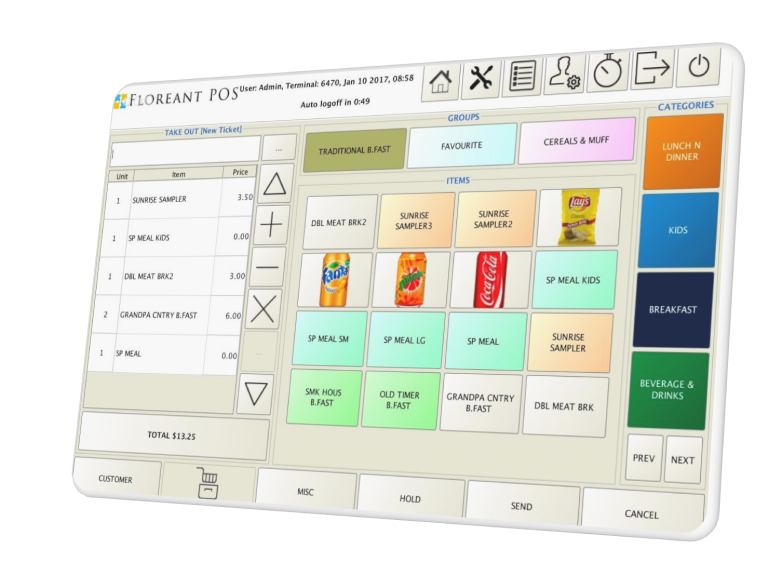
Floreant POS is free and open source, handles configurable items and delivery, and installs on hardware you already own — a reasonable starting point for an independent pizzeria that wants to avoid a multi-year contract. ORO POS adds support and the connected online ordering side.
If you are weighing the wider market first, our comparison of Square and Toast covers the two systems most pizzerias look at, and the hardware guide covers what you actually need on the counter. Whatever you choose, run the half-and-half test before you sign anything.